Pho
Beef pho from bones. Brisket and bones boiled clean, then simmered 3½ hours with charred onion, charred ginger and toasted star anise, cinnamon and cloves, seasoned with fish sauce, poured boiling over paper-thin raw beef.
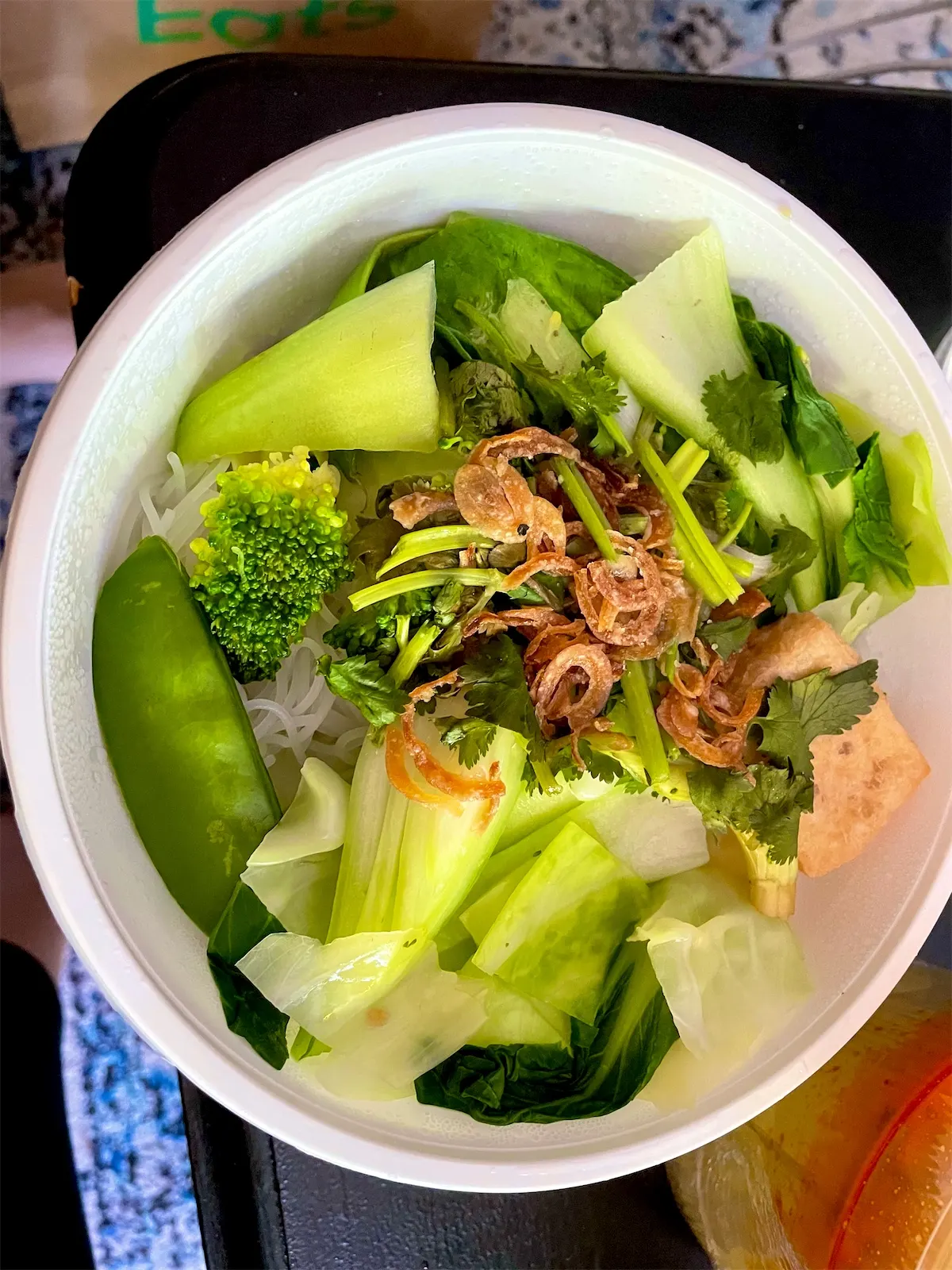
A big bowl lands in front of you, steam fogging your glasses. Clear broth that smells of charred onion, warm spice and beef, slippery rice noodles, a few rosy slices of meat cooking in the heat. You tear in herbs, squeeze lime, add a dab of chilli, and pick up chopsticks in one hand and a spoon in the other. That's pho (say it closer to "fuh"), Vietnam's beloved noodle soup. It's only about a century old, yet it carries Chinese, French and Vietnamese history in every slurp.
Background
Pho has three parts: the broth, the rice noodles and the herbs and garnishes 3. The broth is everything. Chef Peter Cuong Franklin, quoted by the Michelin Guide, simmers beef bones, brisket, flank, charred onion and spices for a full day or overnight, until it rivals a French consommé 3. Good fish sauce matters too; Phu Quoc Island makes some of the world's best 3.
Vietnamese diners eat it with chopsticks, a legacy of Chinese influence. Vietnam is the only Southeast Asian country where chopsticks are the everyday tool 3.
History
Pho appeared in northern Vietnam between about 1900 and 1907, and Nam Định province usually gets the credit as its birthplace 1. The timing matters. Under French colonial rule, Vietnamese people began eating more beef; before that, cattle were mostly work animals and families ate pork and chicken 1.
One account from a Vietnamese food site ties pho to industry. The French built Indochina's largest textile factory in Nam Định in 1889, and by 1933 it employed more than 10,000 workers. French demand for beef, the story goes, pushed local vendors to add it to their soups 4.
The name sparks a friendly fight. Some trace "phở" to the French pot-au-feu, a slow-boiled beef dish. Others trace it to the Cantonese ngưu nhục phấn, beef noodles, sold by Chinese street vendors 13. Both sides have a case, and the soup itself sits neatly between them.
Early pho walked the streets. Gánh phở sellers carried a whole kitchen balanced on a shoulder pole, and they spread the dish through Hanoi in the early 20th century 4. Writers noticed. Journalist Nguyễn Văn Vĩnh wrote of missing pho while in Paris in 1906, and in 1934 the poet Tú Mỡ wrote "Phở Đức Tụng", praising the humble soup as something truly Vietnamese 4.
Then history split the country. After the 1954 partition, northerners who moved south took pho with them, and southern cooks changed it: sweeter broth, plus bean sprouts and fresh herbs piled on the side 1. After 1975, refugees carried pho around the world, and by the 1990s it was mainstream in the United States 1. English dictionaries added the word in 2007 1.
Customs, rules and rituals
North and south still argue, cheerfully, about the right bowl. Northern pho stays simpler; southern pho comes with a plate of herbs and sprouts for you to add yourself 1.
Hard times left their own ritual. During the 1980s, under the American embargo, Vietnam faced severe food shortages, and people joked about phở không người lái, "driverless pho": a bowl with little or no meat 4. The broth carried on even when the beef couldn't.
Pho now has its own day. Tuổi Trẻ newspaper started the Day of Pho in Ho Chi Minh City in 2017, and in 2018 Vietnam officially recognised 12 December as the date, with a gala in Hanoi, "the widely accepted birthplace of pho" 2. Writing contests such as "Memories of Pho" invite people to share their stories 2. Japan has celebrated its own Pho Day every 4 April since 2017 2.
Place in human experience
Pho is a soup made by encounters. Chinese noodles and chopsticks, French beef, Vietnamese fish sauce and herbs all meet in one bowl 13. Some see a colonial story in it; others see Vietnamese cooks taking whatever history handed them and making it delicious.
It's also a soup of movement. Shoulder-pole vendors walked it through Hanoi 4. Northern families carried it south in 1954, and refugees carried it across oceans after 1975 1.
And it's a soup of memory. A journalist homesick in Paris in 1906 longed for it 4. People who lived through the lean 1980s still laugh about driverless pho 4. The Day of Pho's writing contest exists because nearly everyone has a pho story 2.
So next time you add a handful of basil and sprouts, you're casting a vote in a century-old north–south debate. Choose wisely, then slurp.
Recipe inspiration
This is a Sunday pot. Four hours of almost nothing: char, boil, rinse, then the pot ticks away while the kitchen fills with star anise and burnt onion. Restaurants simmer it all day 3. This version takes the shortcut that matters, meat and bones together, because bones alone take too long to taste of beef and meat alone gives no body 5.
The broth freezes beautifully. Make it once and you have pho on a Tuesday in the time it takes to boil the kettle and soak the noodles.
Additions & substitutions
- Chicken pho (phở gà). Swap the beef and bones for a whole chicken, plus 1 kg chicken wings or backs. Simmer 1½ hours, lift the chicken out when cooked, shred it, and use the same charred onion and ginger. Go lighter on the spices: 2 star anise, 1 cinnamon quill.
- Northern style. Skip the bean sprouts, basil and hoisin. Serve with spring onion, coriander, lime and fresh chilli only, the way Hanoi eats it 1.
- Pressure cooker. After the 5-minute boil and rinse, everything into the pressure cooker for 1 hour on high, natural release. Clear broth, a quarter of the time.
- Beef cuts. Chuck instead of brisket for the simmered meat 6. Eye fillet, sirloin or rump for the raw slices.
- Rare beef worries. Dip the raw slices in the boiling pot for 10 seconds before they go in the bowl 5.
- Rock sugar instead of white sugar, if you have it, the way Andrea Nguyen's family makes it 6. Crush it and add to taste.
Expert tips
Shopping
- Two kinds of bones. Ask the butcher for marrow bones (body and richness) and meaty bones such as shin or knuckle (flavour) 56.
- Dried flat rice noodles, "rice sticks" or "bánh phở", about 5 mm wide. Fresh ones from an Asian grocer's fridge are better still.
- Good fish sauce. It's the main seasoning, so taste matters. Phu Quoc fish sauce is the one to look for 3.
- Whole spices, not ground: star anise, cinnamon quills, cloves, coriander seed. Ground spice makes the broth muddy.
Preparing
- Char hard. Over a gas flame, under the grill, or in a smoking dry pan, until the skins are black in patches and the onion has softened 56. 15 minutes on an open flame 6.
- Toast the spices in a dry pan for 3 minutes, until you can smell them across the kitchen 5.
- Never boil the pot. Barely trembling, small bubbles only. A rolling boil emulsifies the fat and clouds the broth.
- Freeze the steak 15 to 30 minutes before slicing. It firms up and you can cut it almost see-through 56.
Make ahead, or for a crowd
- Broth keeps 4 days in the fridge, 3 months frozen. Chill it overnight and the fat sets on top: lift it off in one piece.
- Brisket keeps 3 days, wrapped, in the fridge. Slice it cold, it cuts neater.
- For 12, double everything in your biggest stockpot (12 litres or more) and set the herbs out as a help-yourself platter.
Serving suggestions
Put the herb plate in the middle of the table: Thai basil, coriander, bean sprouts, lime wedges, sliced chilli. Hoisin and sriracha in little dishes, for dipping the meat, not for dumping in the broth. Chopsticks in one hand, spoon in the other. Start with fresh rice paper rolls, or serve bánh mì for anyone not up for soup.
Pho
Published 4 Oct 2026
Ingredients
Broth
- 1.5 kg beef brisket, in one piece
- 1 kg meaty beef bones (shin or knuckle)
- 1 kg marrow bones
- 2 large onions, halved, skin on
- 150 g ginger, halved lengthwise
- 10 star anise
- 4 cinnamon quills
- 4 cardamom pods
- 3 cloves
- 1½ tbsp coriander seeds
- 3.5 litres water
- 2 tbsp sugar
- 1 tbsp salt
- 3 tbsp (40 ml) fish sauce
Bowls (per person)
- 50 g dried flat rice noodles, or 120 g fresh
- 30 g raw beef eye fillet, sliced paper-thin
- 3 to 5 slices of the simmered brisket
- Thinly sliced onion and spring onion
Herb plate
Method
- Char the aromatics. Heat a heavy dry frying pan over high heat until it smokes. Put in the onion and ginger, cut side down, and leave them a few minutes until black, then turn and char the other sides 5. Or hold them over a gas flame. They should be blackened in patches and smell sweet and smoky 6.
- Toast the spices. In a dry pan over medium-high heat, toast the star anise, cinnamon, cardamom, cloves and coriander seeds for 3 minutes, shaking the pan, until fragrant 5. Tie them in muslin or a tea bag if you have one.
- Boil clean. Put the brisket and all the bones in a big stockpot, cover with cold water and bring to a hard boil. Boil 5 minutes 5. Grey scum floats up: that's the point. Tip everything into a colander, rinse the meat and bones under the tap, scrub out the pot.
- Start the broth. Back into the clean pot: meat, bones, onion, ginger, spices and the 3.5 litres of water. Bring up slowly to a bare simmer. Skim any foam in the first 20 minutes.
- Simmer 3 hours. Uncovered, small bubbles only 5. The house should smell of anise and roast onion.
- Rest the brisket. Lift the brisket out; it should be tender when poked with a fork. Plunge it into a bowl of cold water for 10 minutes so the surface doesn't dry and darken 6, then wrap and refrigerate.
- Reduce. Simmer the bones on, uncovered, another 40 minutes 5.
- Strain and season. Strain through a fine sieve into a clean pot. You should have about 2.5 litres 5. Stir in the fish sauce, sugar and salt, taste, and adjust. It should taste savoury and a little sweet with the spices behind it, slightly saltier than you'd sip on its own: the noodles drink it.
- Get ready. Freeze the eye fillet 15 to 30 minutes and slice it as thin as you can, across the grain 56. Slice the brisket. Soak dried noodles in warm water 15 to 20 minutes until bendy 6. Bring the broth to a rolling boil.
- Blanch the noodles. Dunk a portion at a time in a sieve into a pot of boiling water for 10 to 20 seconds, until they go limp 6. Shake dry and drop into a warm bowl.
- Build the bowl. Brisket and raw beef on the noodles, sliced onion and spring onion on top. Ladle over about 400 ml of boiling broth, straight from the pot. The raw beef turns pink as you watch: medium rare, the traditional way 5.
- Serve at once with the herb plate, hoisin and sriracha.
Notes
- Broth cloudy? It boiled hard, or the first boil was skipped. Still tasty. Next time, a bare simmer.
- Broth thin or weak? Too much water or too short a simmer. Reduce it hard for 20 minutes, then season again.
- Too much anise? Fish the spice bag out sooner. It's done its work after 1½ hours.
- Beef grey, not pink? The broth wasn't at a rolling boil when it went in, or the slices were thick. Freeze longer, slice thinner.
- Noodles gluey? They were boiled like pasta. Soak, then a 10 to 20 second dunk.
- Greasy? Chill the broth and lift off the fat, or skim with a ladle.
Cooked this?
Sign in to say you cooked it or leave a comment.
Comments
Sources
- "Pho", Wikipedia, Wikimedia Foundation. https://en.wikipedia.org/wiki/Pho
- "Vietnam celebrates December 12 as national Day of Pho", Tuổi Trẻ News, 13 December 2018. https://news.tuoitre.vn/news/lifestyle/20181213/vietnam-celebrates-december-12-as-national-day-of-pho-official/48103.html
- "Pho", Michelin Guide. https://guide.michelin.com/en/article/dining-out/%E8%A3%BD%E4%BD%9C%E5%87%BA%E8%89%B2%E8%B6%8A%E5%8D%97%E6%B2%B3pho
- "Pho: A Complete History of Vietnam's Most Renowned Dish", Ẩm Thực Hiện Đại. https://amthuchiendai.vn/en/pho-a-complete-history-of-vietnams-most-renowned-dish/
- Nagi Maehashi, "Vietnamese Pho recipe", RecipeTin Eats, https://www.recipetineats.com/vietnamese-pho-recipe/
- Andrea Nguyen, "Beef Pho (Pho Bo)", Viet World Kitchen, https://www.vietworldkitchen.com/wprm_print/beef-pho-pho-bo